
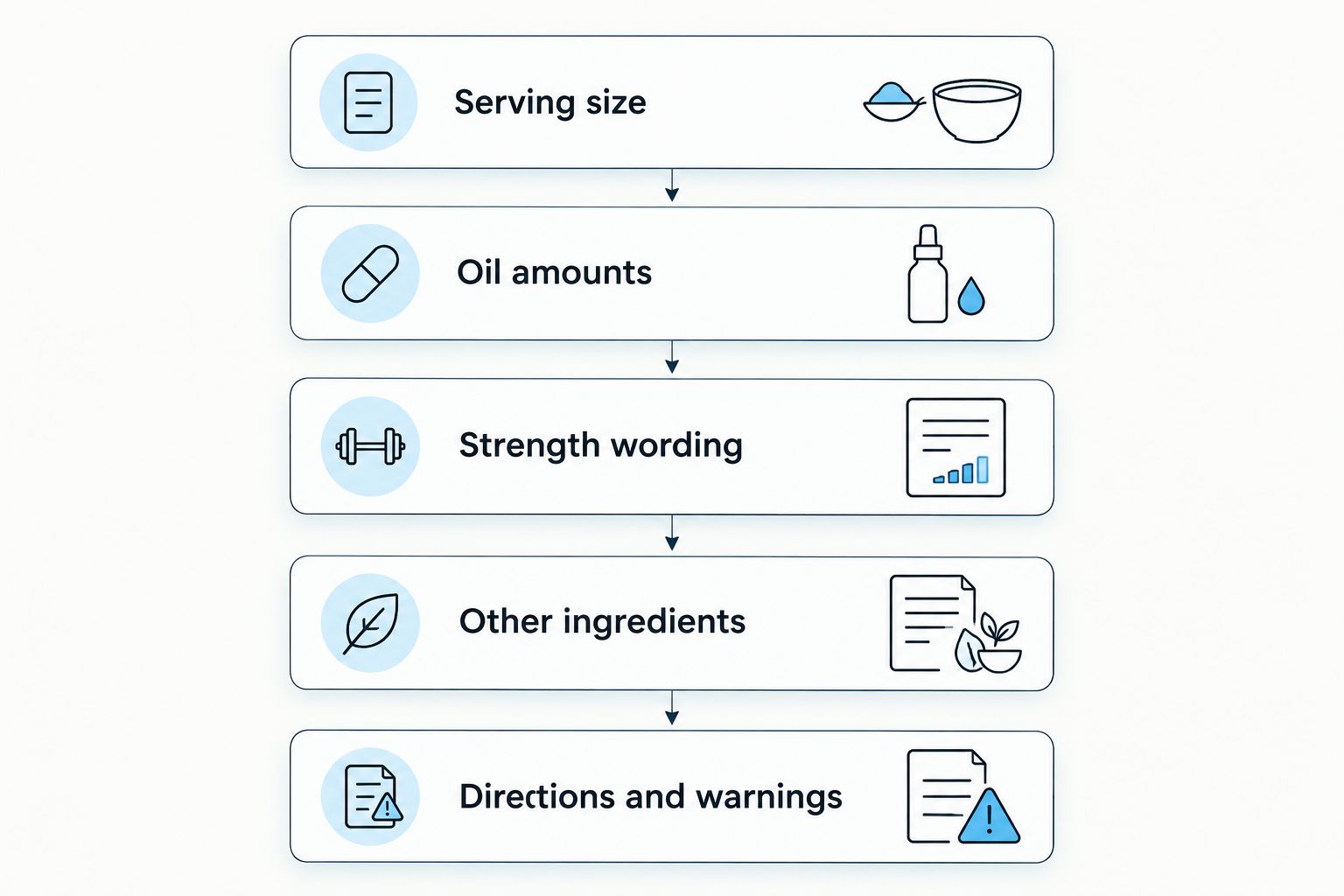
Check oregano oil softgels with black seed oil by reading the serving size, the amount of each oil, the full ingredient list, and the warnings together. A large number on the front does not tell you how much of each ingredient you get, and a combined formula does not establish better results.
- Compare oregano oil softgels using the Supplement Facts panel, not front-label strength claims.
- Black seed oil in a blend does not establish better results than oregano oil alone.
- Check serving size, ingredient amounts, softgel materials, directions, and warnings before buying.
- Olivasmarket lists a combined oregano oil and black seed oil softgel; review the current label before choosing.
Why this matters
A supplement name tells you what to investigate. It does not settle whether the formula suits you. Two bottles can mention the same botanicals while presenting different serving instructions, ingredient amounts, or capsule materials.
For your 2026 shopping checklist, separate three questions: what is in the bottle, what the label actually supports, and whether taking it makes sense for you. This guide applies that approach to the oregano oil softgels listed by Olivasmarket, without treating product wording as proof of a health benefit.
Buy only when you can explain the serving in plain language. If you cannot tell how much you would take or which ingredients you would swallow, pause before checkout.
What should you check on oregano oil softgels with black seed oil?
Start with the Supplement Facts panel, then read the remaining label. Keep the product title nearby, but do not use it as a substitute for the ingredient details.
Read the serving size
Find how many softgels make up a serving. Then check whether the listed ingredient amounts apply to that serving rather than to each individual softgel.
A bottle count and a serving count describe different things. You need the serving size and directions before you can judge how the bottle fits your routine. Do not assume that one softgel equals one serving.
Find the oil amounts
Look for oregano oil and black seed oil in the Supplement Facts panel. Record the amounts exactly as written, including the units and whether the label lists them separately or within a blend.
If the label provides only a combined blend amount, that total does not reveal the amount of each oil. A longer ingredient list is not a reason to fill in the gaps yourself. An undisclosed individual amount remains undisclosed.
Check the strength wording
Read any reference to concentration, extract ratios, or plant equivalents alongside the actual ingredient amount. Those statements describe different aspects of a formula; they are not interchangeable measures of what is inside the softgel.
If a label uses an equivalent amount, identify what it is equivalent to. Do not compare that figure directly with another bottle’s oil weight unless both labels clearly use the same basis.
Read other ingredients
The softgel shell and the contents both matter. Check the other-ingredients list for shell materials, carrier oils, and any additional ingredients relevant to your preferences or allergies.
Do not infer that a softgel is vegetarian, vegan, or free of a particular allergen from the botanical ingredients alone. An oil-based filling says nothing about the shell. Look for clear wording that applies to the finished product.
Review directions and warnings
Read the suggested use, warning statements, and storage instructions before deciding whether the product fits your day. Do not turn a suggested serving into a personal recommendation simply because the bottle is easy to swallow.
If you take medicines, are pregnant or breastfeeding, or are choosing a supplement for a child, ask a qualified healthcare professional before use. Bring the complete label. A product name alone leaves out details needed for that conversation.
How do the label options compare?
Choose the ingredient format first. Only then compare bottles within that format. A combined softgel and a single-botanical supplement answer different shopping preferences, even when both mention oregano.
| Option | Best for | Useful feature | Limitation |
|---|---|---|---|
| Oregano-only formula | Shoppers seeking oregano without an added black seed oil ingredient | Keeps the botanical comparison focused on oregano | Does not include black seed oil; other ingredients still need checking |
| Oregano and black seed oil formula | Shoppers specifically seeking both botanicals together | Combines the named oils in one formula | Requires checking both ingredients; the combination does not establish better results |
| Blend with undisclosed individual amounts | Shoppers willing to accept limited ingredient-level detail | Shows the total blend amount when declared | Does not let you compare each oil’s amount independently |
These categories can overlap. A combined formula can disclose each oil separately or present them within a blend. Read the actual panel rather than assuming that a particular product name guarantees a particular level of detail.
For a 2026 comparison, keep the evidence separate from the format. A softgel describes how you take the product. It does not prove effectiveness, suitability, purity, or independent testing.
Why oregano oil softgel labels vary
Different labels emphasize different parts of a formula. Use these distinctions to understand the wording, not to rank products by the boldest claim.
- Ingredient combination: Oregano oil alone and oregano oil with black seed oil are different formulas. Decide whether you want both before comparing other details.
- Serving basis: Amounts stated per serving must be read with the number of softgels in that serving. Bottle count does not resolve that question.
- Amount disclosure: Separately listed oils provide a different level of detail from a blend total. A total cannot tell you the proportion of each ingredient.
- Concentration wording: Oil weight, extract ratios, and plant-equivalent statements describe different things. Compare like with like.
- Softgel materials: The shell and other ingredients affect whether a formula meets your dietary preferences. Botanical contents alone do not answer that question.
More label detail makes a comparison easier; it does not automatically make a supplement more effective. Treat transparency as a shopping aid, not a clinical result.
Where does the Olivasmarket option fit?
The listed oregano oil softgels with black seed oil combine the two named botanicals in a softgel format. That is the useful starting fact for this comparison.
Olivasmarket oregano oil softgels suit shoppers seeking oregano oil and black seed oil together in a softgel format. That describes the product format, not a promise about what taking it will do.
The practical advantage is the combined format if you already want both ingredients. The limitation is that the product name alone cannot settle serving details, individual oil amounts, shell materials, or personal suitability. Check the current label rather than reading those details into the name.
For a 2026 purchase, keep your decision narrow: does the documented formula match what you intended to buy? If a detail matters to you, confirm it before ordering. Do not replace a missing answer with a favorable assumption.
Is oregano oil with black seed oil better than oregano oil alone?
A combined formula is not automatically better than oregano oil alone. Adding black seed oil changes the ingredients, but the ingredient count does not establish a better health outcome.
Choose a combined formula only if you have a reason to seek both botanicals and have checked the complete label. If your goal is to compare oregano amounts specifically, a clearly disclosed oregano amount makes that task easier than an unspecified share of a blend.
The same rule applies to traditional-use language. A history of use is not a guarantee of safety or effectiveness for your intended use. Keep the shopping claim and the health question separate.
Does a larger strength number mean a better softgel?
A larger front-label number is not enough to identify a better softgel. First establish whether it describes the oil itself, an extract equivalent, a blend total, or an amount per serving.
Write down what the figure measures before comparing it. If the units or measurement basis differ, stop the direct comparison. Otherwise, you risk choosing the larger-looking claim rather than the formula you intended to buy.
For your 2026 shortlist, give clear disclosure priority over dramatic wording. Clear amounts help you understand a product. They still do not tell you which amount is appropriate for you.
How can you judge value without chasing a bigger bottle?
Start with suitability. A bottle is not a useful purchase if its ingredients conflict with your needs, its directions do not fit your routine, or you cannot interpret its label.
Once the formula passes those checks, compare the number of servings rather than the number of softgels alone. Use each product’s stated serving size consistently. Do not count a bottle as lasting longer by quietly reducing the suggested serving.
Keep these questions beside your shopping list:
- Can you identify the amount of each ingredient you care about?
- Do you understand how many softgels make up the stated serving?
- Have you checked shell materials and other ingredients?
- Are the directions and warnings clear?
- Does the formula match a reasoned choice rather than a front-label promise?
You do not need to add another supplement to make a purchase feel worthwhile. Choose for a defined need, not for a fuller cabinet. If the information does not support a decision, leave the bottle off your shortlist until you have an answer.
What can a supplement label tell you about safety?
A label gives you ingredients, directions, and warnings to review. It does not provide a personal medical assessment. Your medicines, health conditions, and other supplements belong in that assessment too.
The FDA does not approve dietary supplements for safety and effectiveness before they are marketed. For US shoppers in 2026, the FDA’s dietary supplement guidance and the NIH Office of Dietary Supplements’ consumer information are useful references for understanding that distinction.
Look carefully at any testing or certification claim. Identify the organization, what was tested, and whether the claim applies to the specific product. A seal or quality statement does not, by itself, prove a health benefit.
If you seek help from a pharmacist or clinician, show the Supplement Facts panel and other-ingredients list together. Include the directions and warnings. That is more useful than asking whether oregano oil is generally “good for you.”
FAQ
What should I look for when buying oregano oil softgels?
Look for a clear serving size, ingredient amounts, other ingredients, directions, and warnings. Compare the Supplement Facts panels rather than relying on front-label strength wording.
Is oregano oil with black seed oil better than oregano oil alone?
Oregano oil with black seed oil is not automatically better than oregano oil alone. The combined formula includes another botanical, but that does not establish better results or personal suitability.
Does one softgel always equal one serving?
One softgel does not always equal one serving. Read the serving size before interpreting the listed ingredient amounts or comparing bottle counts.
How do I know how much black seed oil is in a blend?
Check whether the Supplement Facts panel lists black seed oil separately with an amount. A combined blend total does not tell you the amount of each ingredient.
Are oregano oil softgels vegetarian?
Do not assume oregano oil softgels are vegetarian. Check the shell materials and an explicit vegetarian statement that applies to the finished product.
Does the FDA approve oregano oil supplements before sale?
The FDA does not approve dietary supplements for safety and effectiveness before they are marketed. Being sold as a supplement does not establish that a product is suitable for you.
Can I take oregano oil softgels with my medicines?
Ask a pharmacist or clinician to review the complete formula alongside your medicines before taking it. Bring the Supplement Facts panel, other ingredients, directions, and warnings.
Can I use supplement softgels instead of black seed oil for cooking?
Do not treat supplement softgels as a substitute for cooking oil. Follow the product’s intended use and choose an oil explicitly sold for food use when cooking.
One last thing
Take a photo of the full label before adding a supplement to your routine. Keep the serving size, ingredients, directions, and warnings in the same record. You will have something concrete to revisit or show a healthcare professional.
The strongest shopping decision is the one you can explain without repeating the front of the bottle. Know what the serving contains, why you chose the formula, and which questions you still need answered.