
Read oregano oil softgels by checking the serving size, the amount of oregano oil per serving, and any stated carvacrol concentration—not just the largest number on the front. Keep actual oil weight separate from any dried-herb equivalent, and check whether the listed amount covers oregano alone or a blend. This 2026 guide shows you how to make those distinctions before buying.
- Compare oregano oil softgels using the same serving size and ingredient basis, not the largest front-label number.
- The FDA’s Supplement Facts format separates serving size from the amount per serving.
- Carvacrol percentage describes concentration; it does not replace the amount of oregano oil.
- For oregano and black seed oil blends, check whether each ingredient has its own listed amount.
Why this matters
A large number can describe several different things: actual oil, the herb used to make an extract, or ingredients combined in one serving. Those numbers do not answer the same shopping question. A strength comparison only works when you compare the same ingredient on the same basis.
When shopping at Olivasmarket, use the current package label to check the details that matter to you. A product name tells you what to investigate; the Supplement Facts panel and directions tell you how the serving is presented.
How do you read oregano oil softgel strength labels?
Start with the back panel. For a US supplement purchase in 2026, the FDA’s dietary supplement labeling guidance is the reference for understanding serving size, amounts per serving, and ingredient declarations. Front-label wording is not a substitute for those details.
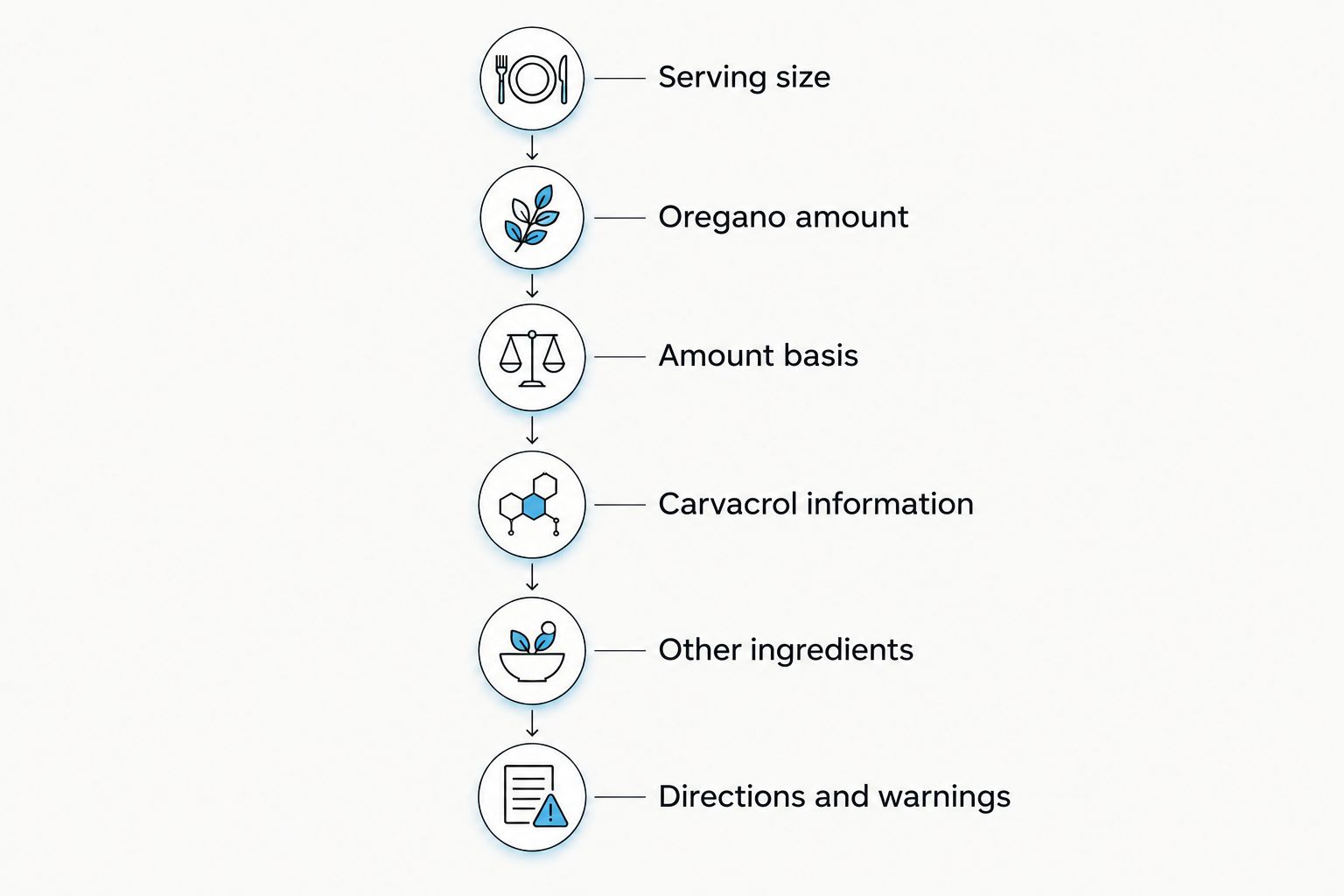
Follow this order:
- Serving size. Find how many softgels make up the labeled serving. Do not assume the amounts refer to a single softgel.
- Oregano amount. Identify the amount specifically assigned to oregano oil or oregano extract. Keep those ingredient descriptions separate.
- Amount basis. Check whether the number describes the ingredient actually present or an equivalent amount of starting herb.
- Carvacrol information. Look for a stated concentration and what ingredient it applies to. A percentage needs a clear reference point.
- Other ingredients. Identify black seed oil, carrier oils, the capsule shell, and any other listed ingredients.
- Directions and warnings. Read these separately from the strength figures. A larger amount is not an instruction to take more.
Write down the ingredient name alongside its amount. A number copied without its label can turn an extract equivalent into an apparent oil dose, or a blend total into an apparent oregano amount.
Which label numbers can you compare directly?
Use this table to decide whether two figures belong side by side. Each type of information has a use—and a limit.
| Label information | Best for | What it tells you | What it does not establish |
|---|---|---|---|
| Amount per serving | Comparing labeled servings | The declared amount for the stated serving | The amount per softgel unless you account for serving size |
| Actual oregano oil amount | Comparing oil quantities | How much oregano oil is declared | Carvacrol concentration unless separately stated |
| Dried-herb equivalent | Understanding an extract claim | The stated relationship to starting plant material | The weight of oil inside the softgel |
| Carvacrol percentage | Comparing declared concentration | The proportion of carvacrol in the specified ingredient | Total carvacrol amount without the relevant ingredient weight |
| Blend total | Understanding combined ingredients | The amount declared for a mixture | Each ingredient’s individual amount unless disclosed |
Choose the comparison your label can actually support. If one label gives actual oil weight and another gives only a herb equivalent, those headline numbers are not a direct strength comparison.
Serving size: the number that sets the comparison
The Supplement Facts panel reports amounts per serving. That serving can contain more than one softgel. Read the serving-size line before treating any ingredient amount as the amount in a single capsule.
To calculate an amount per softgel, divide the declared amount per serving by the number of softgels in that serving. Keep the ingredient wording attached to the result. Dividing a blend total does not reveal the oregano portion of that blend.
The directions answer a different question: how the manufacturer tells you to use the product. Do not replace those directions with a calculation based on another bottle’s serving size.
For your 2026 shopping notes, record both the serving size and the amount per serving. This keeps a smaller serving from looking weaker simply because you compared it with a larger serving elsewhere.
Actual oil weight and herb equivalent are different claims
An actual oil amount describes oil. A dried-herb equivalent describes an amount of starting plant material represented by an extract claim. Even when both use milligrams, they measure different things.
An extraction ratio also needs context. It describes a relationship between starting material and extract; it does not independently state the amount of carvacrol in the finished serving. Read the ratio alongside the extract amount and ingredient description.
Unit conversions are straightforward: 1 gram (g) equals 1,000 milligrams (mg), and 1 milligram equals 1,000 micrograms (mcg). Converting units helps you compare like with like, but it cannot turn herb-equivalent weight into actual oil weight.
Watch the words beside the figure. Terms such as oil, extract, equivalent, and blend are part of the claim—not small print to skip. If the basis remains unclear after reading the package, ask for clarification before using that number to choose a bottle.
Carvacrol percentage: concentration is not the whole amount
Carvacrol is a constituent of oregano oil. A declared carvacrol percentage describes its proportion in the ingredient to which that percentage applies. It is not the same measurement as the total amount of oregano oil.
To calculate a declared carvacrol amount, you need both the relevant oil amount and a clearly stated percentage. Multiply that oil amount by the percentage divided by 100. Do not apply an oregano oil percentage to the total weight of an oregano-and-black-seed-oil blend.
A percentage is measured on a scale where 100% means the whole of the specified material. That makes the denominator essential: percentage of the oregano oil, percentage of an extract, or percentage of something else must be clear.
For a 2026 comparison, record the oil amount and concentration in separate fields. A higher percentage alone does not establish a higher amount per serving, better suitability, or a better result.
Oregano oil alone and blends: check what the total includes
A blend needs an extra label check. Oregano oil and black seed oil are separate ingredients, so a combined amount does not automatically tell you how much oregano oil you receive.
Olivasmarket’s oregano oil softgels suit shoppers seeking oregano oil and black seed oil in one softgel. The listed Oregano & Black Seed Oil Softgels combine those two ingredients. Check the current Supplement Facts panel for their individual amounts, serving size, and any declared constituent concentrations.
| Format | Best for | Useful feature | Buying limitation |
|---|---|---|---|
| Oregano oil alone | Shoppers seeking an oregano-only formula | Keeps the ingredient comparison focused on oregano | Still requires checks for oil amount, concentration, and carrier ingredients |
| Oregano and black seed oil blend | Shoppers who specifically want both oils | Combines both ingredients in one formula | A combined total cannot establish the amount of either oil separately |
Neither format wins simply by containing more ingredients. Choose the format that matches what you intended to buy, then compare its disclosed amounts. An added ingredient is a reason to check the formula, not proof of greater oregano strength.
Why oregano oil softgel strength claims vary
Differences in label presentation can make similar-looking numbers mean different things. Check these factors before calling one product stronger:
- Serving size. The stated amount can cover different numbers of softgels.
- Ingredient form. Oil, extract, and starting-herb equivalents describe different quantities.
- Concentration. A carvacrol percentage adds information only when its basis is clear.
- Blend composition. A combined total can include ingredients other than oregano oil.
- Disclosure detail. Separate ingredient amounts support a more specific comparison than a blend total alone.
- Units. Grams, milligrams, and micrograms need conversion before numerical comparison.
Keep these checks separate from personal suitability. A label can explain composition without establishing whether you should take the supplement. Ask a pharmacist or clinician about use alongside medicines or other supplements.
Does a bigger milligram number mean stronger oregano oil?
A bigger milligram number only means more of the quantity that the label actually names. If it names dried-herb equivalent or a combined blend, it does not establish more oregano oil or carvacrol. Compare ingredient form, serving size, and concentration before drawing that conclusion.
Can you work out carvacrol from the percentage alone?
A carvacrol percentage alone is not enough to calculate an amount per serving. You also need the amount of the ingredient to which that percentage applies. Without both, keep the percentage as concentration information rather than treating it as a dose.
How do you judge value without choosing the largest number?
Judge value by the clearly described serving you actually want to buy. Check the current purchase total, the labeled servings per container, and the ingredient details before comparing bottles. A larger headline amount does not make an unclear formula a better purchase.
FAQ
What should I check first on oregano oil softgels?
Check the serving size first, then read the oregano ingredient amount for that serving. Keep actual oil weight, herb equivalent, and blend totals separate.
Is the milligram amount on the front the amount in each softgel?
Do not assume the front-label milligram amount applies to each softgel. Read the Supplement Facts serving size and the wording attached to the amount.
Is oregano herb equivalent the same as oregano oil?
Oregano herb equivalent is not the same measurement as actual oregano oil weight. It describes a stated relationship to starting plant material, not simply the amount of oil inside the capsule.
Does a higher carvacrol percentage mean a better supplement?
A higher carvacrol percentage describes a higher declared concentration on the same basis, not an automatically better supplement. Check the relevant oil amount, directions, and whether the formula suits your needs.
Can I count black seed oil toward the oregano oil amount?
Black seed oil does not count as oregano oil. If a label gives a combined blend total, look for separately declared amounts before comparing its oregano content.
What should I check on Olivasmarket’s oregano oil softgels before buying?
Check the current Supplement Facts panel for serving size, ingredient amounts, and any declared concentrations. Read the directions, other ingredients, and warnings before deciding whether the blend fits your needs.
Should I take extra softgels to match another product’s strength?
Do not increase your serving just to match another product’s headline number. Follow the package directions and ask a pharmacist or clinician about changing how you use a supplement.
One last thing
The smallest words beside a strength number can change the entire comparison. Circle the ingredient name, underline the serving size, and note whether the amount says oil, extract, equivalent, or blend. That simple reading habit is more useful than choosing the biggest figure.
For your next Olivasmarket purchase in 2026, keep a photo of the current label with your shopping notes. Buy on clear ingredient information, not a number separated from its meaning.