
Compare an organic cotton tote bag by its material details, usable shape, handle fit, care instructions, and stated carrying limits—not by its name alone. Choose one that fits your usual groceries and your route home; organic cotton does not, by itself, establish load capacity, waterproofing, or insulation.
- Compare an organic cotton tote bag by material, usable space, handles, care, and carrying guidance.
- Olivas Market offers a roomy organic cotton tote with long handles for shoulder carry.
- Organic cotton describes the fiber; check certifications, construction, and care separately.
- Choose grocery bags around your usual shopping load, not how full the product photo looks.
Why this matters
A grocery bag needs to work when it is full, not just look good when it is empty. A wide opening helps you pack, while comfortable handles matter on the walk home.
At Olivas Market, the Olivas Organic Cotton Market Tote is best for shoppers seeking roomy organic cotton storage and long shoulder handles. Those are the useful details in its description. Check care instructions, dimensions, and carrying guidance before choosing it for your regular grocery load.
For your 2026 shopping checklist, separate what a listing states from what a photograph suggests. A relaxed fabric shape can look spacious without showing how a carton, loaf, and produce bag fit together.
How do you compare organic cotton tote bags for grocery trips?
Start with the details that affect your actual trip. Use the same checklist for every bag so an attractive print does not distract you from a poor fit.
| Comparison point | What to look for | What it does not establish |
|---|---|---|
| Material details | Fiber composition and support for any organic claim | Carrying strength or waterproofing |
| Usable space | Dimensions, opening, and base shape | A guaranteed grocery capacity |
| Handle fit | Handle length and attachment points | Comfort under your particular load |
| Construction | Clear views of seams, base, and handles | A tested load limit unless stated |
| Care instructions | The maker's cleaning and drying directions | Permission to use any wash setting |
| Carrying guidance | A stated limit or intended use | Suitability for every grocery trip |
Compare like with like. A material claim answers a different question from a carrying limit, and neither replaces care instructions.
Material details
Look for a clear statement of fiber composition. The phrase organic cotton identifies a material claim, but a shopper still needs to distinguish the main fabric from any lining, handles, or other components.
If certification matters to you, look for the named standard and an explanation of what it covers. Do not turn a general organic claim into an assumption that every part of the finished bag has the same certification.
Usable space
Read measurements alongside the bag's shape. A flat tote and a tote with a shaped base do not pack the same way, even when their front views look similar.
Think about awkward groceries first. Bread needs room without crushing, a carton needs a stable position, and a long vegetable needs an opening that accommodates it. Use your familiar shopping items as a practical reference.
Handle fit
Decide whether you want to carry the bag in your hand or over your shoulder. Long handles can support shoulder carry, but their length alone does not tell you how comfortable a loaded bag will feel.
Check how the handles join the body. Clear close-up photos are useful; distant lifestyle photos are less helpful for judging stitching and attachment points.
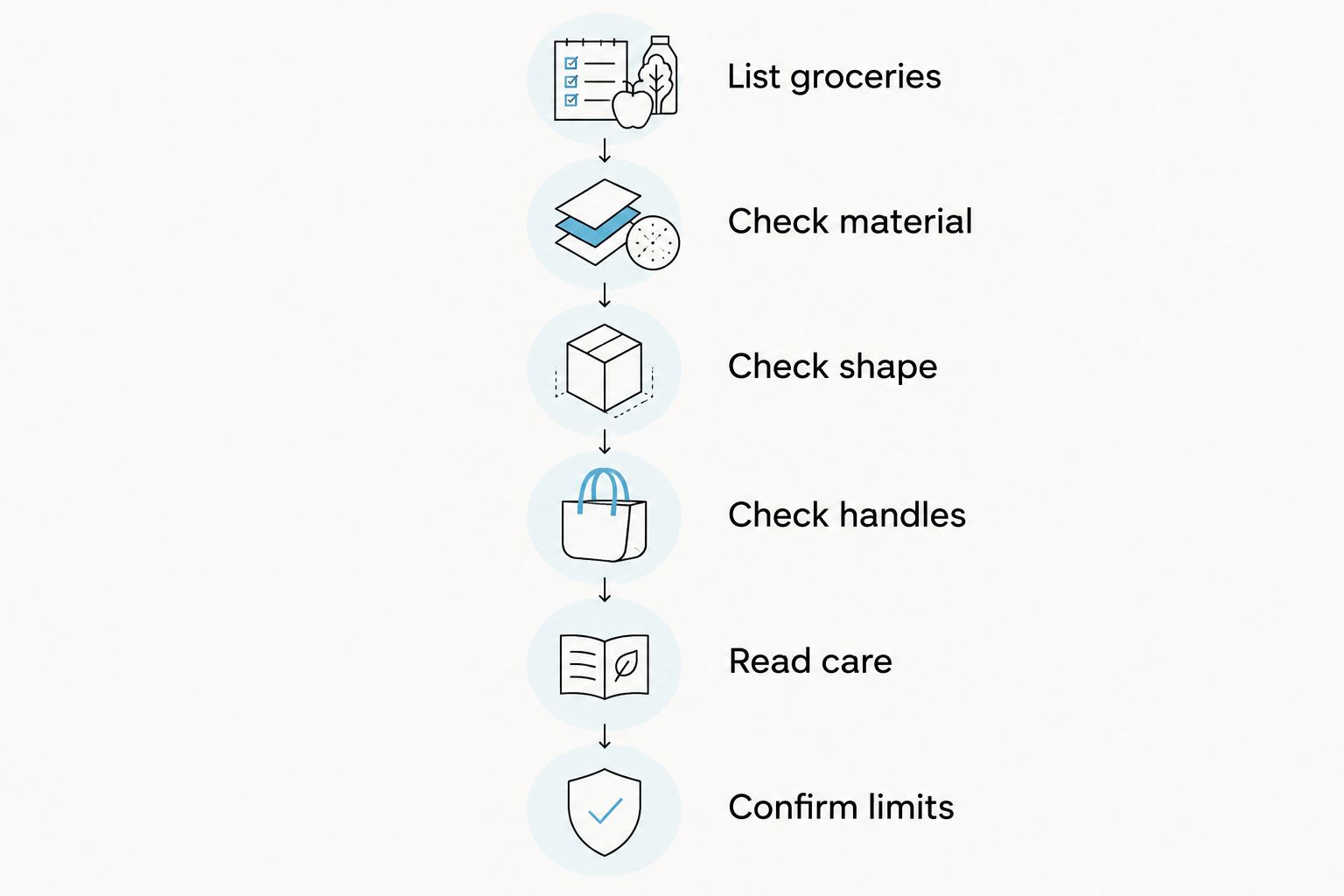
A simple grocery-tote comparison process
Use this sequence before adding a new bag to your basket. It keeps the decision focused on what you carry and how you travel.
- List groceries. Write down the bulky, heavy, and delicate items you buy regularly. Include the items that are hardest to pack, not just the ones that fit easily.
- Check material. Read the composition and the wording behind any organic claim. Keep material facts separate from broader environmental promises.
- Check shape. Compare the opening, base, and measurements with a bag you already own. This gives unfamiliar dimensions a useful reference.
- Check handles. Decide how you will carry the load. Consider your coat, your walking route, and whether you need a hand free.
- Read care. Find the cleaning and drying directions before buying. Choose care requirements you will actually follow.
- Confirm limits. Look for carrying guidance and any restrictions. Do not treat an oversized-looking bag as permission to carry an unlimited load.
The order matters. If a bag cannot accommodate your usual groceries or your preferred carrying style, its print and color will not fix that mismatch.
Why grocery-tote suitability varies
The right organic cotton tote bag depends on more than the fabric. These practical differences change how useful a bag is for your shopping routine:
- Grocery mix. Bulky produce, boxed goods, jars, and delicate food create different packing needs.
- Bag shape. The opening and base affect how you arrange groceries and reach items at checkout.
- Carrying route. Moving a bag from cart to car is different from carrying it home on foot.
- Handle arrangement. Length and attachment affect how you hold the bag and where the load rests.
- Cleaning needs. A bag used for groceries needs care instructions that fit the way you use it.
- Temperature needs. An organic cotton claim does not establish insulation for chilled or frozen food.
For a 2026 purchase, use these factors to rule out poor matches before comparing appearance. You are buying a carrying tool first, even when the design is part of the appeal.
How should you judge value without comparing unlike bags?
A useful bag earns its place by fitting your routine. Compare the current purchase total only after you have checked material, size, carrying guidance, and care. Otherwise, you are comparing bags that might serve different needs.
Start with what you already own. If your existing tote fits your usual groceries and remains suitable for use, identify the specific problem a new bag would solve before buying another.
For your 2026 comparison, write a short reason beside each candidate: easier shoulder carry, a more useful shape, or clearer care guidance. If you cannot identify a practical reason, pause the purchase rather than choosing on appearance alone.
Avoid assuming that an organic label guarantees a longer service life. Material sourcing and durability are separate questions, and a higher purchase total is not proof of better construction.
What are the advantages and limits of a cotton grocery tote?
A cotton tote offers a straightforward format for carrying groceries. Its suitability still depends on the individual bag, the way it is packed, and its care requirements.
| Feature | Practical advantage | Limit to keep in mind |
|---|---|---|
| Fabric body | A flexible shape can accommodate different items | A soft bag does not necessarily hold itself upright |
| Open top | Gives you direct access while packing | Does not provide a secure closure unless one is specified |
| Long handles | Support shoulder carry when the fit works for you | Do not establish comfort with every load |
| Organic cotton material | Gives you a material claim to examine | Does not establish insulation or water resistance |
| Roomy design | Offers space for bulky items | Does not replace a stated carrying limit |
Treat these as trade-offs, not promises about every tote. Only apply a feature to a specific product when its description or images support it.
For an Olivas Market organic cotton tote bag, the same rule applies: use the stated roominess and long handles as starting points, then check the remaining details. Choose for the trip you make, not the trip a staged photo suggests.
How do you check whether a tote will fit your groceries?
Use a familiar bag as your reference, then compare the new bag's measurements and shape. Set out the types of groceries you normally carry and notice which items need width, depth, or protection from pressure.
Do not build a capacity estimate from a product photo alone. Without a reliable scale reference, a picture cannot tell you whether your usual carton or container will sit as expected.
Pack around delicate items
Keep firm, stable items below food that crushes easily. Place bread and delicate produce where other groceries will not press down on them.
This is a packing decision, not a reason to exceed carrying guidance. If the load becomes awkward to lift or control, divide it rather than trying to use every bit of available space.
Keep temperature needs separate
A plain cotton tote is not an insulated grocery bag unless the product specifically includes insulation. Do not use an organic material claim as evidence of temperature control.
Plan an appropriate way to transport chilled and frozen food. Also keep raw animal products contained and separated from ready-to-eat groceries to reduce cross-contamination.
Does organic cotton mean the whole bag is certified?
Organic cotton does not establish that the whole bag is certified. Read the exact claim and check whether any named certification applies to the fiber, fabric, or finished product.
For a 2026 listing, look for clear supporting information rather than relying on a leaf symbol or natural-looking product photo. Neither is a substitute for a stated standard and its scope.
Can you machine-wash an organic cotton tote bag?
Machine-wash an organic cotton tote bag only when its care instructions permit it. Cotton content alone does not establish safe wash settings for the finished bag, including its print, handles, and other components.
Read drying instructions too. Do not assume that a bag suitable for washing is also suitable for every drying method.
Do you need a new tote for every kind of grocery trip?
A new tote is not necessary if a bag you already own fits the trip and remains suitable for use. Match the bag to the load, then make separate arrangements for groceries that need temperature control or extra containment.
For an occasional small shop, your needs differ from a bulky restock. There is no reason to treat the largest-looking tote as the default choice.
FAQ
What's the best organic cotton tote bag for grocery shopping?
The best organic cotton tote bag for your groceries fits your usual load, carrying style, and cleaning routine. Compare dimensions, handle fit, construction, and stated limits before choosing.
Is an organic cotton tote bag waterproof?
An organic cotton claim does not establish that a tote bag is waterproof. Check for an explicit waterproofing claim and its limitations instead of assuming the fabric will contain spills.
How much weight can an organic cotton tote bag hold?
Use the carrying limit stated for the specific bag. Do not infer a safe load from fabric appearance, bag size, or an organic cotton label.
Are long handles better for grocery trips?
Long handles are useful when you want shoulder carry and the fit works for you. Check clearance over your usual clothing and consider how you will carry a loaded bag.
Can I use a cotton tote for frozen groceries?
A plain cotton tote does not provide verified insulation just because it is made from organic cotton. Use suitable temperature-controlled transport for frozen groceries and follow food-storage guidance.
What should I check before buying a tote from Olivas Market?
Check whether the tote's roominess and long shoulder handles match your shopping routine. Read the current product details for dimensions, care instructions, and carrying guidance before deciding.
Does organic cotton mean a tote will last longer?
Organic cotton alone does not establish a longer service life. Construction, use, loading, and care also affect how a finished bag holds up.
One last thing
Compare the empty bag with the job it must do when full. A tote can look generous laid flat yet pack awkwardly around your usual groceries.
Before your next 2026 purchase, identify the item that gives your current bag the most trouble. Use that item—not the product photo—as your first fit check.